
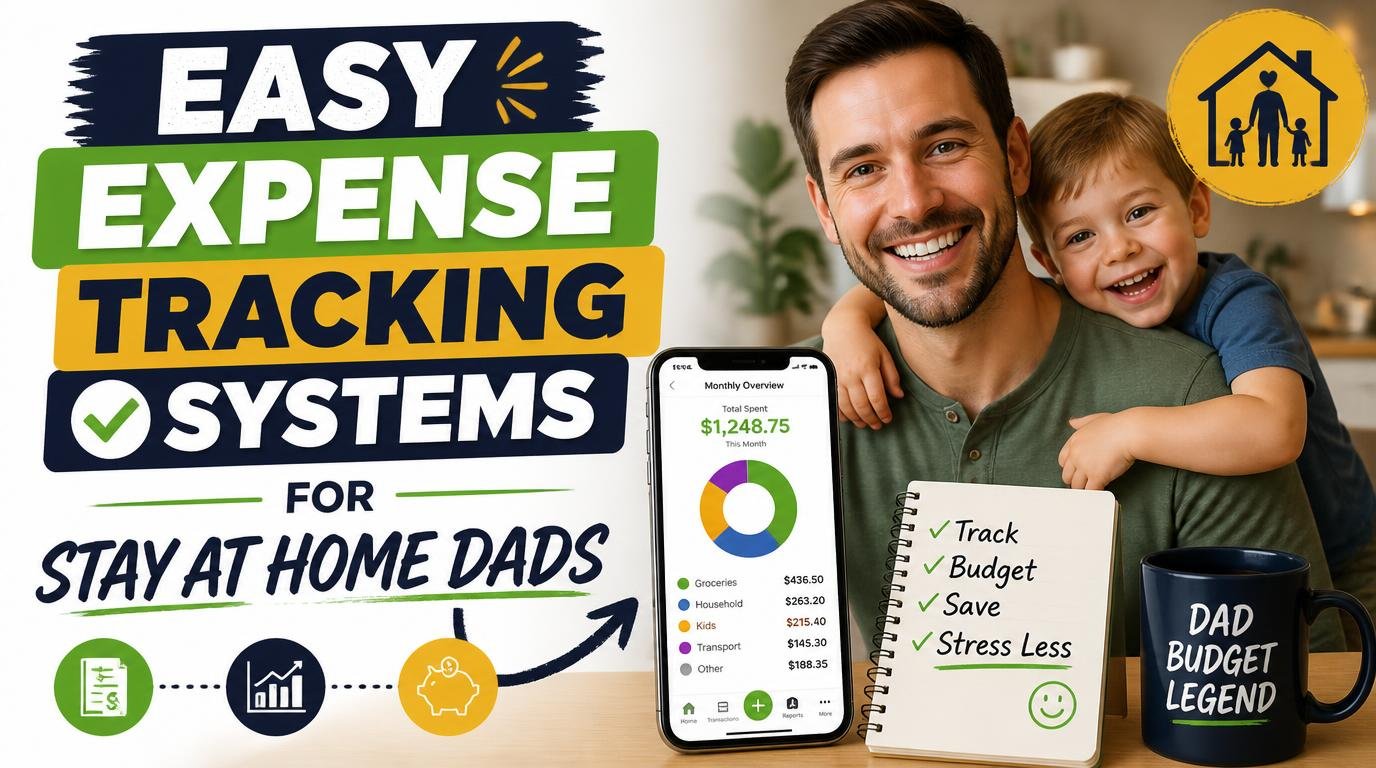
I became a stay-at-home dad when our second kid arrived and the daycare math stopped making sense. For six months I had no real idea where the money went. My wife would ask “did we really spend that much on groceries?” and I’d just shrug. The turning point was finding a battered notebook in the junk drawer and writing down every dollar for one week. It was ugly, incomplete, and it changed everything.
Why Expense Tracking Feels Impossible for Stay-at-Home Dads — and How to Fix It
Most tracking advice assumes you sit at a desk with a spreadsheet open. A stay-at-home dad is breaking up crayon fights and reheating coffee for the third time. The system has to survive chaos, not just look good on paper.
The secret is lowering the bar until tracking becomes easier than not tracking. A two-second entry beats a perfect system you abandon by Thursday. Everything below takes under ten minutes a day.
- Track the same day, not “later” — memory lies after 48 hours
- Capture the amount and what it was — the category can wait
- One system at a time — three apps is a hobby, not a habit
- Review weekly, not daily — trends beat single receipts
1. The One-Notebook Method That Started It All
Before apps, before spreadsheets, there is a notebook and a pen by the kitchen counter. Every time money leaves your hands or your card, you write one line: date, amount, what. “Tue — $34.20 — groceries.” That is the whole system.
At the end of the month you flip through thirty days in about twenty minutes and circle anything that surprises you. My first month revealed $86 in drive-through coffee. It caught a leak no app had ever shown me.
2. The Weekly Envelope Reset
Every Sunday night, take five envelopes labeled Groceries, Kids, Household, Fun, and Buffer. Put the week’s budgeted amounts in each. When an envelope is empty, that category waits until Sunday.
The visual part matters — you see the grocery envelope getting thin by Thursday, so Friday becomes a pantry dinner night instead of a pizza order.

3. The Fridge Whiteboard Tally
Stick a small whiteboard on the fridge with four columns: Groceries, Kids, House, Other. Anyone who spends writes the amount in the right column the moment they get home. No login, no app, no excuses.
We each add our spending when we get home, then snap a photo Sunday before erasing. Thirty seconds a visit, one running monthly total.
4. The 5-Minute Nightly Phone Log
Set a phone alarm for 9 PM labeled “money minute.” When it buzzes, open your notes app and type today’s spending from memory — card notifications help fill the gaps. Three to five lines, done before the alarm stops.
I do this on the couch while the kids’ show plays. Ninety percent of my tracking accuracy comes from this one tiny habit.
5. The Two-Bank-Account Split
Open a second free checking account and split money on payday: fixed bills in one, everything variable in the other. You only need to track the variable account, because the bills account runs on autopilot.
Our variable account gets $900 every two weeks, and that is the only number I watch. Low balance means pantry week. Half the tracking battle is shrinking what you have to track.

6. Receipt Photos Sorted on Sundays
Every receipt goes into one phone photo the moment you get it — no sorting, no filing, just a crumpled-paper photo dump. On Sunday, spend ten minutes looking through the week’s photos and typing the totals into one note.
The photos also save you at tax time and for returns. I found a $40 receipt last year that I would have thrown away, and the store honored the return. Ugly system, real money.
7. The Grocery Receipt Game With the Kids
Once a month, lay the grocery receipts on the table and have the kids help you add them up with a calculator. Whoever guesses closest to the total picks Friday’s dinner. Suddenly my six-year-old cares about unit prices.
It takes fifteen minutes and does two jobs: you get your monthly food total without effort, and the kids absorb price awareness by osmosis. My daughter now says “that’s three ice creams” about everything, which is honestly useful math.
8. The Subscription Audit Day
Twice a year, sit down with your bank statement and highlight every recurring charge: streaming, apps, memberships, that gym nobody visits. Cancel everything you have not used in the last month.
My first audit killed $47 a month in forgotten subscriptions — a cloud storage plan from 2021 and a kids’ app trial that kept billing. That is $564 a year found in one afternoon. Subscriptions are the only expense that grows while you sleep.

9. Color-Coded Calendar Tracking
Hang a big paper calendar and assign each category a marker color: green for groceries, blue for kids, red for unplanned. Mark each day’s total with a dot.
By mid-month you see the pattern at a glance — too many red dots means the month is leaking. I spotted that our “quick store runs” were happening twice a week when the calendar showed red dots every Tuesday and Friday.
10. The “Nothing Sheet” for Zero-Spend Days
Keep a simple sheet on the fridge where you write an X on every day you spend nothing at all. The goal is not perfection — it is making zero-spend days visible and slightly competitive with yourself.
We average eight X’s a month now, up from three when we started. Each X is roughly $40 we did not spend, so the sheet quietly saves us about $200 a month.
11. The Kid-Expense Separate Ledger
Kids’ costs hide inside every category — their food is in groceries, their clothes in household, their activities nowhere. Keep one separate page or note just for kid spending: diapers, school fees, shoes, birthday parties.
When I did this, I learned our two kids cost about $410 a month outside of food and housing. Knowing the real number ended every argument about “kid stuff.”

12. Monthly Category Check-Ins With Your Partner
Once a month, sit down together for twenty minutes with your totals — notebook, whiteboard photo, app, whatever you used. No blame, just: here is what we spent, here is what surprised us, here is what changes next month.
The rule is no lectures about the past month, only plans for the next one. We do it over coffee on the first Saturday.
13. The Cash-Only Weekend Challenge
Take out $100 in cash on Friday and leave the cards at home until Monday. Every weekend purchase comes from the cash. When it is gone, the weekend’s spending is done — no judgment, just a hard boundary.
Weekends were our leak: takeout, toy store trips, “while we’re out” purchases. The cash limit cut our weekend spending nearly in half.
14. The Annual One-Page Money Review
Every January, put the whole year on one page: total earned, total spent, total saved, and the three biggest surprise expenses. One page, big numbers, no detail. It takes an hour with your monthly totals.
My one-pager last year showed we spent more on eating out than on our car insurance, which reordered our priorities fast. You cannot fix what you cannot see, and one page is enough to see everything that matters.

The Biggest Tracking Mistake Stay-at-Home Dads Make
Trying to track everything perfectly from day one. You buy the fancy app, set up twenty categories, log every penny for four days, then miss one afternoon and quit for three months. Perfection is the enemy of the habit.
Start with one category — usually groceries or eating out — and track just that for two weeks. Once it is automatic, add another.
A Dead-Simple Template You Can Copy Tonight
Open your notes app and create this: “Week of [date]. Spent: ___. Biggest: ___. Surprise: ___. Next week: ___.” Fill it in every Sunday in under five minutes.
That is the whole template. After a month you will have four snapshots that show exactly where your money goes, written by you in plain words, no categories or charts required.
What to Do With the Numbers Once You Have Them
Tracking without acting is just journaling about your money. Pick the single biggest surprise from each month and make one change — cancel one subscription, set one grocery limit, plan one no-spend weekend.
One change a month compounds fast. A year of single changes saved us over $3,000 without a single budget meeting that felt like punishment.
Conclusion
That junk-drawer notebook is long gone, but the habit stuck. I still track daily, my wife and I still do our Saturday coffee review, and we finally know where the money goes — which turned out to be the whole point. You do not need the perfect system. You need the one you will still be using in March.