
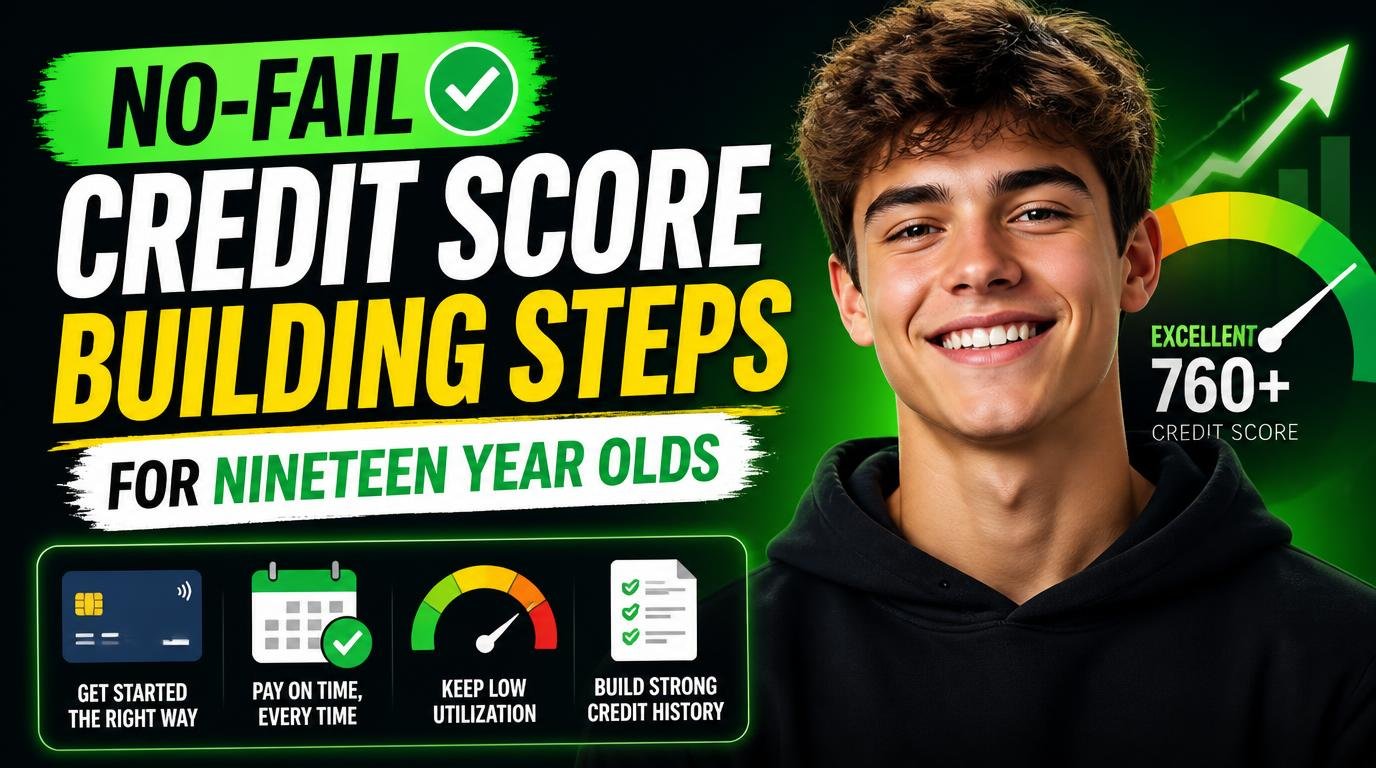
I got my first credit card at nineteen and treated it like free money for exactly four months. By twenty I had a $1,400 balance, a 580 score, and a collection call that made my stomach drop. It took me two years to dig out. Everything below is what I wish someone had sat me down and explained before I ever signed that application — the safe, boring path to a score that opens doors.
Why Building Credit at Nineteen Matters More Than You Think
Your credit score quietly controls your twenties: apartment approvals, car loan rates, even some job applications. Starting at nineteen gives you the one thing money cannot buy — time.
Building credit from zero is simpler than fixing it. You need one card, tiny charges, on-time payments, and patience. Every step below is designed to be almost impossible to mess up.
- Never spend money on the card you do not already have in your bank account
- Set everything to autopay before you ever swipe
- Use the card for small, regular purchases only
- Check your score monthly, but do not obsess over daily changes
1. Get a Secured Card With a $200 Deposit
A secured card requires a refundable deposit — usually $200 to $500 — which becomes your credit limit. You cannot get into real trouble because you cannot spend more than you deposited, and most graduate to unsecured cards within a year.
I started with a $300 secured card from my bank. Twelve months of on-time payments later, they refunded my deposit and raised my limit to $1,500.
2. The Single-Autopay Trick
Before you make your first purchase, log into the card account and set autopay for the full statement balance. Not the minimum — the full balance. Do this on day one, before life gets busy.
Autopay is the single highest-impact move on this list because payment history is 35% of your score. One missed payment can drop a young score 80 points. Autopay turns your best habit into something you cannot forget.

3. Keep Utilization Under 10 Percent
Utilization is how much of your limit you use. On a $500 limit, keep your balance under $50 when the statement closes. Below 10% is ideal; below 30% is acceptable; maxed out is a score killer.
You do not have to stop spending — just pay the card down before the statement date. I put $200 of gas on my card monthly and paid $170 before the statement — utilization showed 6%, score kept climbing.
4. The Phone Bill on Your Card Method
Put one recurring bill — your phone bill is perfect — on the card and then put the card in a drawer. The bill pays itself, autopay pays the card, and your score builds while you literally do nothing.
My phone bill was $45 a month on a $500 limit: 9% utilization, paid in full automatically. For eight months that was my entire credit strategy, and my score rose from nothing to 690.
5. Become an Authorized User on a Parent’s Card
If a parent has a card with years of on-time payments and low balances, ask to be added as an authorized user. Their history appears on your report, which can add years of positive history overnight.
I never touched it — I did not even carry it — but my average account age jumped and my score gained 40 points in two months.

6. Never Close Your First Card
The length of your credit history matters, and your first card anchors it. Even after you get better cards, keep the first one open with one small charge a year — a coffee, a subscription, anything.
Closing my first card would have cut my average account age in half. Instead I buy one tank of gas on it every January. It costs me nothing and protects the oldest line on my report.
7. Set Up Free Score Monitoring
Your bank or a free service will show your score monthly at no cost. Check it once a month — same day, like the first — and watch the trend, not the number. Slow upward is the goal.
I check on the first of every month with my coffee. Seeing 640 become 660 become 690 over a year was genuinely motivating. What gets measured gets managed, even when the measuring takes thirty seconds.
8. The Gas-and-Groceries Only Rule
Limit the card to two categories — gas and groceries — and pay for everything else with debit. This keeps spending naturally capped at necessities, which keeps balances small and payments painless.
When I restricted my card to gas and groceries, my monthly card spending settled around $250 on a $1,000 limit. No budgeting app needed; the rule did the budgeting.

9. Pay Twice a Month If You Carry a Balance
If a balance ever slips past the statement date, pay half on payday and half two weeks later instead of waiting for the due date. You cut interest charges and show active, responsible payment behavior.
I carried $300 once after a car repair and paid $150 twice instead of $300 once. The interest was a few dollars instead of twenty, and my report showed two on-time payments that month. Small move, real savings.
10. Wait Six Months Before a Second Card
One card for the first six to twelve months is plenty. Each application creates a hard inquiry that dings your score a few points, and young files are sensitive. Let the first card build a track record first.
I waited eleven months before my second card. By then my score was 710 and I qualified for a real rewards card. Patience at nineteen buys you better cards at twenty.
11. Dispute Errors Immediately
About one in five credit reports has an error. When you check your free annual reports, look for accounts you do not recognize, wrong balances, or late payments you never made. Dispute them online — it takes fifteen minutes.
I found a $90 medical bill on my report that I had already paid. One dispute, thirty days, gone — and my score jumped 25 points.

12. Don’t Co-Sign Anything Yet
Friends will ask you to co-sign apartments, car loans, phone plans. Do not. Co-signing makes their debt your debt on paper, and at nineteen your thin file cannot absorb someone else’s missed payment.
My roommate asked me to co-sign his car loan and I said no — awkward for a week, fine forever. He missed two payments that year.
13. Build an Emergency Fund to Protect the Score
A $500 emergency fund in savings is credit protection. Without it, every surprise — flat tire, phone screen, textbook — lands on the card and starts the balance spiral that kills young scores.
I built mine $25 a week for five months, and it covered a dead laptop in month six. The emergency fund is not savings; it is a shield around your score.
14. Check Your Full Report Every Year
Once a year, pull your full reports from all three bureaus — it is free. Read every line: accounts, inquiries, personal info. You are looking for fraud, errors, and anything you forgot about.
I do mine every birthday. Last year I found an old store card I had opened at eighteen and forgotten — still open, now contributing to my account age.

The Three Score-Killers at Nineteen
Maxing out the card, missing even one payment, and applying for five cards in a month. Each one can undo a year of good behavior in thirty days.
I did the first two and paid for it for two years. The boring path — small charges, autopay, patience — is boring because it works.
A One-Page Starter Checklist
Open a secured card. Set full-balance autopay. Put your phone bill on it. Keep utilization under 10%. Check your score monthly. That is five lines, and it is the entire system for year one.
Tape it to your wall. When all five are done, you are building credit correctly, and there is nothing else to buy, download, or optimize.
What Comes After 720
Once your score crosses 720, better cards with real rewards and higher limits become available. From zero to 750 took me three years of boring consistency — no hacks, no shortcuts, just the checklist.
Conclusion
That $1,400 balance at twenty taught me more about credit than any article could, but I would trade the lesson for the two years it cost me. Start boring, stay boring, and let time build the score. Your twenty-five-year-old self will thank you every time they sign a lease.