

I worked night shift for three years — 7 PM to 7 AM, sleeping while the world was awake. My finances were a mess because every bill system assumed I was conscious during business hours. I missed a car payment sleeping through the “pay by” day, and the late fee stung more than the exhaustion. So I built a bill system for someone whose “morning” is 4 PM and whose brain is fried half the time.
Why Night Shift Breaks Normal Bill Paying
Normal advice assumes a normal schedule: check accounts in the morning, call the bank at lunch, pay bills after dinner. Night shift nurses live inverted — home at 8 AM wired and exhausted, asleep until 3 or 4, with two functional hours before the next shift.
The answer is not more discipline — you already keep people alive at 3 AM. It is a system that runs on autopilot and needs almost no awake-brain. These methods are built for automation, simplicity, and an upside-down life.
- Automate everything — a tired brain is unreliable
- One weekly money check, ten minutes max
- Pay bills right after payday, before life happens
- Keep a checking buffer against timing mismatches
1. The Payday Power Hour (20 Minutes, Twice a Month)
On every payday, before sleeping, I spent 20 minutes paying every bill due before the next paycheck: rent, car, insurance, utilities. All in one sitting while still in work mode and functional. Then I slept knowing two weeks were covered.
Batching matches night shift energy. Do it once, while alert, instead of remembering five due dates across two weeks of exhaustion. Mine happened at 8:30 AM post-shift, coffee in hand — as routine as clocking out.
2. A Nurse in Scrubs Paying Bills on a Phone Before a Shift
I paid bills on my phone in the parking lot before shifts — ten quiet minutes in the car, knocking out anything due. Odd, but that pre-shift window was one of my most alert times, and the car was the only place nobody needed anything from me.
The phone is your whole finance office on night shift. I saved every biller’s login in my password manager, so paying took seconds. Find your alert window — before shift, after shift — and make it bill time. Routine beats willpower every time.

3. Autopay Everything Fixed
Every fixed bill — rent, car, insurance, loans — went on autopay, no exceptions. A tired nurse at 4 PM cannot be trusted with due dates, and I stopped pretending otherwise. Autopay has not missed once in three years.
The fear is overdrafting, which is why the buffer matters. Set autopay two days after payday, keep a $500 cushion in checking, and the system runs itself. I review the autopay list monthly — the entire maintenance cost.
4. The $500 Checking Buffer
I keep $500 in checking at all times that I pretend does not exist. Not savings, not spending — shock absorption. When autopay and payday misalign by a day, the buffer absorbs it. Zero overdraft fees since starting, after dozens before.
Treat the buffer as the account’s floor. My mental balance is always “actual minus $500.” Two months of tight spending built it, and it has paid for itself many times over in avoided fees and stress.
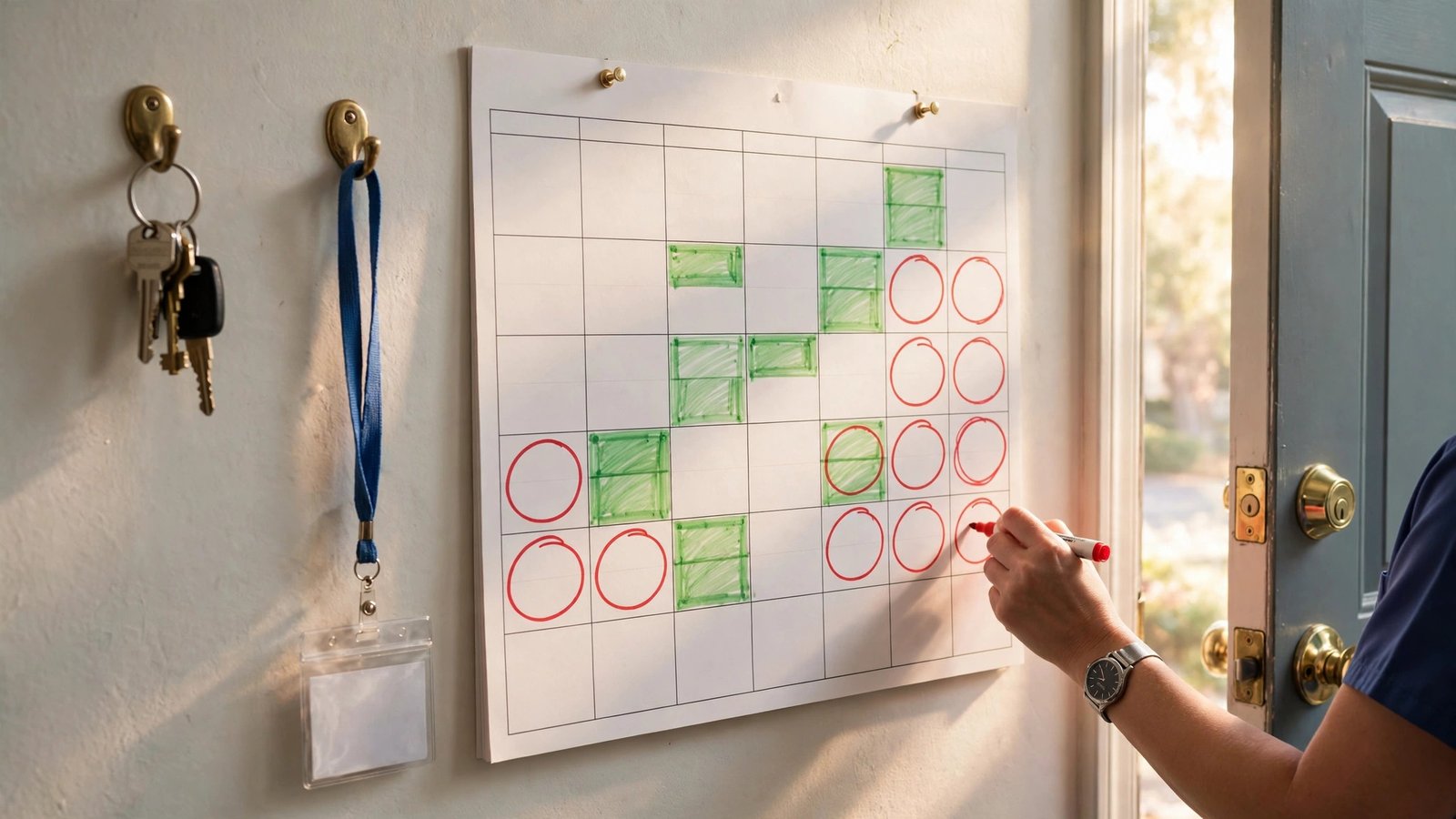
5. A Wall Calendar With Paydays and Due Dates in Bright Colors
I hung a big paper calendar by my front door: paydays green, due dates red. Every shift exit, I saw it. Five minutes monthly to set up — and it caught two near-misses in quarter one, bills I would have forgotten in a nights-stretch fog.
Digital reminders get swiped away half-asleep; a physical calendar is unavoidable. I marked it on the first of each month, and my partner saw it too — two brains on the dates, not one exhausted one.
6. Align Due Dates to Your Paydays
I called every biller and moved due dates to the week after payday — electric, car lender, credit card. All said yes in one call each. Now money arrives, bills leave, and there is never a scary thin-account gap.
Highest-leverage phone project in personal finance, and most people never do it. One afternoon permanently fixed my cash flow. Bills clustered after payday means the rest of the month is just living expenses — much easier to manage.
7. The “Bills Account” Separation
I opened a second checking account just for bills. Every payday, the coming two weeks’ bills moved in automatically; all autopays drew from it. Main checking held only spending money. When spending ran low, I knew exactly why — and bills were never the casualty.
Separation kills the hardest mental math: “is this coffee or the electric bill?” With bills quarantined, spending money is truly spendable. The envelope system for people who never carry cash.
8. A Night Shift Nurse Sleeping Peacefully While Bills Pay Themselves
The payoff hit one afternoon: I woke up, checked my phone, and three bills had paid themselves while I slept. No action, no worry, no late fees. I went back to sleep smiling. That is what a good system feels like — invisible.
This is the goal: your financial life runs while you rest, like the hospital runs while day shift sleeps. Build once, maintain monthly, trust it. Peaceful sleep is priceless on nights, and money worry is its enemy.

9. Weekly 10-Minute Money Check
Every Sunday at 4 PM — my “morning” — ten minutes on accounts: did autopays clear, anything weird, spending okay? Timer on, then done. It caught a double-charged subscription and a fraudulent $40 charge in year one.
The time limit matters. Without it, a “quick check” becomes an hour of anxious scrolling. Paired with my laundry routine, it stuck — habits attach to other habits.
10. Kill Late Fees Forever With Alerts
Text alerts for everything: low balance, payment confirmations, due-date reminders three days out. The safety net under the automation. When car insurance autopay failed on an expired card, the alert told me same-day instead of becoming a lapse.
Twenty minutes to configure, protection forever. Especially valuable on nights, when problems hide for days. Let the robots watch the money while you watch the patients.
11. Meal Prepping Containers Lined Up on a Counter
Night shift eating is a budget killer — 2 AM vending machines, drive-throughs home, delivery on days off. I meal-prepped on days off: a week of containers, real food, grab-and-go. Food spending dropped from $500 to about $300 monthly.
The lined-up containers became a small pride. Better night food meant better work energy, which mattered more than money. Two hours of prep with music on, paid for itself by Wednesday every week.

12. The “Sleep-Deprived Spending” Rule
My rule: no purchases over $30 when sleep-deprived — which on nights is most waking hours. Online shopping at 5 AM post-shift was my weakness; I once bought a $200 espresso machine I never used. The rule killed impulse spending dead.
Sleep deprivation destroys judgment — neuroscience, not character flaw. The rule keeps the credit card away from a compromised brain. Anything still wanted after real sleep was usually worth buying.
13. Save the Shift Differentials
Nights paid a differential — about $4 more per hour, roughly $400 extra monthly. I treated it as invisible and auto-sent it all to savings. The budget ran on base pay; the differential built the emergency fund unfelt.
The night shift superpower: more pay for the same job. Most absorb it into lifestyle, but capturing it is a raise you never spend. Three years of differentials became a $12,000 emergency fund.
14. One Financial Task Per Day Off
Instead of “money days” that never happened: one tiny task per day off. Monday, check investments; Wednesday, review spending; Friday, update the calendar. Five minutes each — too small to skip, together keeping everything current.
Big sessions do not survive night shift life. Tiny distributed tasks do. Small, scheduled, and done beats ambitious and abandoned every time.

The Mistake That Cost Me $400
My costliest mistake: ignoring a “payment failed” email for two weeks during six straight nights. Car insurance autopay, expired card — by the time I noticed: late fee, reinstatement fee, one stressful call.
The fix: the alert system plus a rule — financial alerts get handled before sleep, however tired. Two minutes now saves two weeks of compounding problems.
A Simple Night Shift Bill Calendar
Green paydays, red due dates, paper calendar by the door. Autopay everything fixed, timed two days post-payday. One 10-minute weekly check. One tiny task per day off. Fits on an index card.
Set it up once on a rested day off, then let it run. Build the machine awake so it works while you sleep.
Conclusion
Three years of nights taught me the problem was never discipline — it was a system built for someone else’s schedule. Once I automated bills and buffered checking, money became the easiest part of my upside-down life.