

We have five kids, and for a while our grocery bill looked like a phone number. I used to dread the checkout total the way other people dread the dentist. The shift came the winter our third outgrew everything at once — three kids needing winter coats in the same month nearly broke us. That is when we stopped trying to out-earn our family size and started getting radically smart about spending instead.
How Big Families Spend Less Without Feeling Deprived
Large families have a secret weapon: scale. Buying for seven costs less per person than buying for three — but random spending scales too, and that is what kills big-family budgets.
Frugal living with kids is not about saying no to everything. It is about building systems that make the cheap choice the easy choice. The ideas below saved our family over $6,000 last year.
- Buy the boring stuff in bulk, the fun stuff with intention
- Make the default choice the cheap choice — systems beat willpower
- Involve the kids — they are better savers than you think
- Track one number monthly: total grocery spending
1. The Bulk Pantry That Feeds Seven
Dedicate one shelf or closet to bulk staples: 25-pound bags of rice, oats, flour, beans, and pasta. Bought at warehouse prices, these cost 40 to 60 percent less per pound than grocery-store sizes.
Our bulk shelf holds about $180 of staples and covers three weeks of dinners. The pantry is a savings account you can eat.
2. Hand-Me-Down Clothing Trains
Set up a simple chain: oldest child to next, then to cousins or neighbors, then to donation. Buy new only underwear, socks, and shoes — everything else cycles through the train.
We have not bought new everyday clothes in two years. The train saves us roughly $1,500 a year, and the kids treat hand-me-down arrivals like Christmas. My middle daughter’s favorite jacket has now served three kids.

3. One Big Weekly Cook-Up Day
Pick one day — ours is Sunday — and cook the week’s backbone: a huge pot of rice, two sheet pans of roasted vegetables, a tray of chicken, and a pot of beans. Portion into containers for mix-and-match meals.
Three hours of cooking eliminates fifteen weeknight “what’s for dinner” panics, which is when takeout happens. Our takeout spending fell from $200 a month to under $40.
4. The Family Meal Calendar on the Wall
A big paper calendar in the kitchen with every dinner planned for the month. The kids can see what is coming, which ends the nightly “what’s for dinner” interrogation, and you shop once from one list.
Planning cut our grocery waste to nearly zero — no more mystery vegetables rotting in the drawer. We plan 25 dinners and leave five “wild card” nights for leftovers or cravings. Structure with an escape valve.
5. Buy Nothing Groups in Your Neighborhood
Local Buy Nothing groups — usually on social media — are where neighbors give away furniture, kids’ gear, clothes, and toys for free. Post what you need; offer what you have outgrown. No money changes hands.
Last year we furnished a bedroom, got two bikes, and a barely-used stroller — all free. We gave away outgrown car seats and a crib. The fastest-growing free store in America is your neighbors’ garages.

6. The “Secondhand First” Rule
Before buying anything new, check secondhand: thrift stores, consignment, online marketplaces. Give it 48 hours. Nine times out of ten, you will find what you need for a third of the price.
Our rule found a $400 stroller for $60 and a dining table for $75. The 48-hour wait also kills impulse buys — half the time we forget what we wanted, which tells you everything about whether we needed it.
7. Library Everything
The library is the most underused money-saver for big families: books, movies, video games, museum passes, even tools and toys at many branches. Our library card saves us an estimated $100 a month.
We do a weekly library trip — the kids each get a bag of books, I grab movies for Friday night. Summer reading programs kept five kids entertained for free for two months.
8. The Garden That Cuts the Grocery Bill
You do not need a farm — four raised beds or even containers grow the expensive stuff: tomatoes, herbs, peppers, lettuce. A $40 investment in seeds and soil returns $300 to $500 in produce over a season.
Our small garden supplies all our summer tomatoes and herbs, plus enough zucchini to annoy the neighbors. The kids eat vegetables they grew themselves, which solved the “eat your greens” battle better than any parenting book.

9. One Car Scheduling Instead of Two
If you can manage it, one car with a shared calendar beats two cars with two insurance bills, two maintenance schedules, and two tanks of gas. The second car’s true cost is usually $400 to $600 a month.
We went to one car for a year and saved $5,400. It required a shared calendar and some coordination, but the kids adapted to bus and bike faster than we expected.
10. Free Entertainment Saturdays
Make Saturday the free-fun day: parks, hiking trails, library events, community festivals, beach days. Pack lunch, bring water, spend zero. Kids remember adventures, not admission prices.
Our best family day last year was a free fossil-hunting trip at a state park — total cost $12 in gas. The $80 amusement park trip the month before? The kids barely mention it. Free fun is not lesser fun; it is just less advertised.
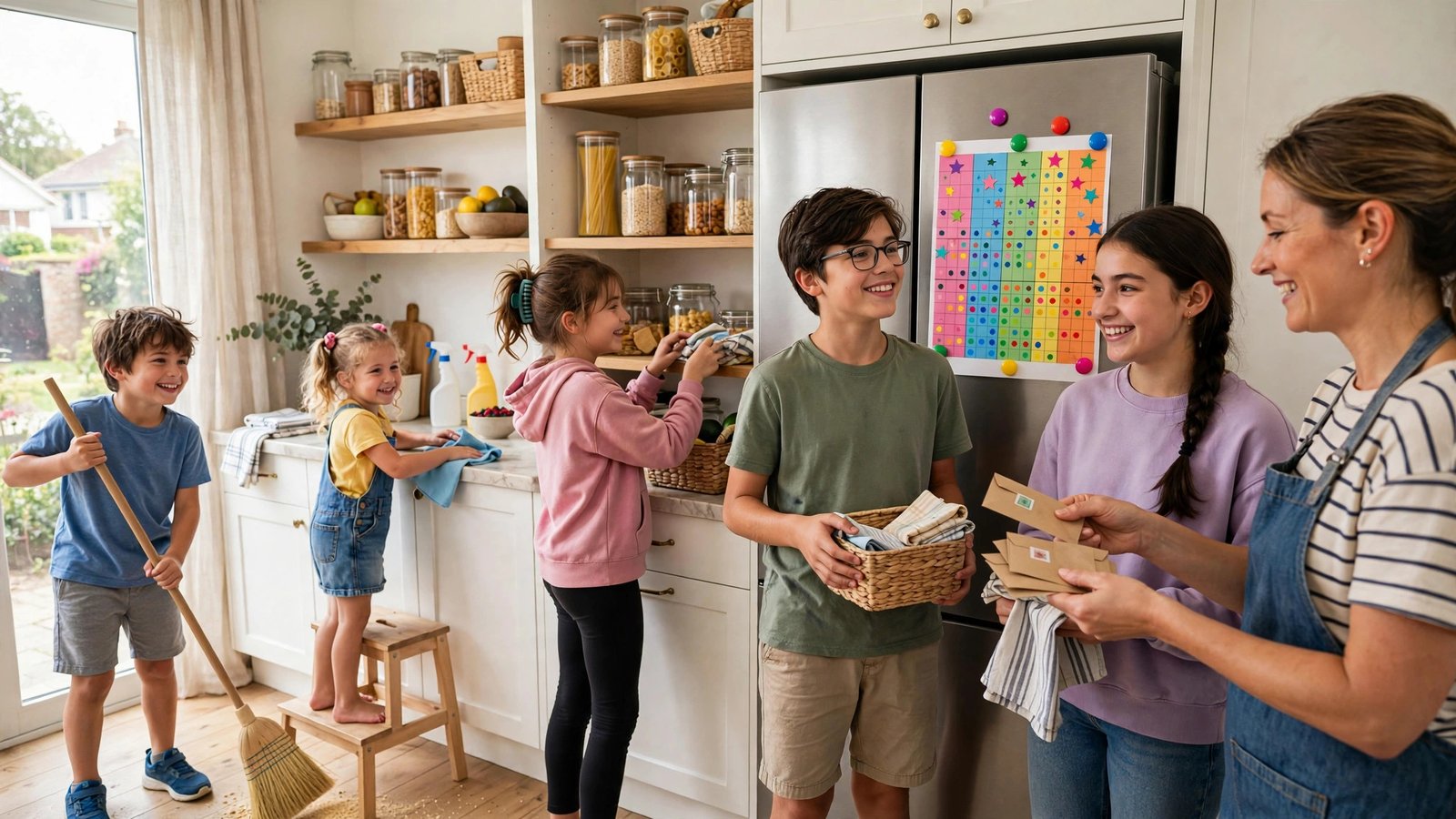
11. Kids’ Chore-Based Allowance System
Each kid gets a base allowance plus paid “bonus chores” — deeper cleaning, yard work, organizing. They learn that money follows effort, and you get a cleaner house for the cost of a few dollars a week.
Our five kids earn $3 to $8 a week each depending on age. They save for their own toys now instead of asking us, which cut our “kid impulse buy” spending by more than half.
12. Bulk Buying With Other Families
Team up with two or three families to split warehouse bulk buys — a 50-pound bag of rice, a case of diapers, a side of beef from a local farm. You get bulk prices without needing bulk storage.
We split a quarter cow with two neighbors last fall: premium beef at $4.50 a pound, filling our freezer for months. Nobody’s garage can hold a whole cow, but three families’ freezers can hold anything.
13. The Annual Insurance and Bills Audit
Once a year, shop your car insurance, phone plan, and internet — call each provider and ask for a better rate, then compare competitors. Loyalty is rarely rewarded; asking is.
Last January’s audit took two hours and saved us $1,140 a year: $600 on car insurance, $360 on phones, $180 on internet. Two hours, $1,140 — that is a $570-an-hour job, and nobody interviews you for it.
14. Teaching Kids the “Want vs. Need” Talk
When kids ask for something, ask back: “Is it a want or a need?” No lecture, just the question. Over time they start asking themselves before they ask you, and the requests drop by half.
My eight-year-old now says “it’s a want, I know” before I can ask — and then usually decides to wait. That one question is doing more for their financial future than any allowance system ever could.

Where Frugal Goes Wrong in Big Families
Skipping preventive care, buying the cheapest everything until it breaks twice, and making kids feel poor instead of smart. Frugality should never cost health, safety, or dignity.
We buy cheap on things that do not matter and spend properly on shoes, mattresses, and doctor visits.
A Family Budget Template
One page, five lines: Income, Housing, Food, Everything Else, Saved. Fill it in monthly in ten minutes. If Food creeps up three months straight, that is your signal to revisit the meal calendar.
We keep ours on the fridge next to the meal calendar. Five lines is all a busy parent of five can maintain — and maintainable beats comprehensive every time.
Your First Three Weekend Wins
Weekend one: join your local Buy Nothing group and post three things to give away. Weekend two: build the bulk pantry shelf with $100 of staples. Weekend three: plan one month of dinners on the wall calendar.
Three weekends, maybe $100 total, and you will feel the difference by month two. Momentum beats perfection — start with the win that is easiest.
Conclusion
That winter of three winter coats taught us the real lesson: we could not shrink our family, so we got smarter instead. Five kids, one income some years, and we are saving more now than when it was just two of us. Frugal is not about having less — it is about wasting less of what you have.