

I got my first job at sixteen scooping ice cream, and I spent every paycheck by the following Friday. Then my older brother showed me his bank app: $2,000 saved from the same kind of job, and he was buying a car. Same town, same pay, same age. The only difference was that he had a plan and I had excuses. I copied his system that week, and by graduation I had $3,400 saved.
Why Most Teen Savings Plans Die by Friday
Most teenagers try to save “whatever is left over,” a plan guaranteed to produce zero. Money sitting in your pocket or checking account gets spent. That is not a character flaw, it is how brains work at every age. Adults beat this with automatic transfers. You can do the same.
A working plan has three parts: a goal with a name and a number, money that moves automatically before you can spend it, and a way to watch the number grow. Everything below is just ways to make those three things happen in a high school life.
- Open your own savings account, separate from spending money
- Split every paycheck automatically the day it lands
- Give every dollar a job: spend, goal, or future
- One big visible goal beats ten vague intentions
1. Open a Real Savings Account (Not the Piggy Bank)
Walk into a bank or credit union with a parent and open a teen savings account. Most are free with no minimum. The key move: do not attach a debit card, or leave the card at home. Money you cannot tap in a store survives.
Keep spending money separate, in checking or cash. The physical separation is the entire strategy. When your paycheck lands, the savings transfer leaves immediately.
2. Split Every Paycheck Into Three Buckets
Every time money comes in, split it three ways before spending a cent. A split that works: 50 percent spending, 30 percent big goal, 20 percent long-term savings. On a $200 paycheck, that is $100 to spend, $60 to the goal, $40 to savings.
Do the split the day money arrives, not “later.” If your app lets you nickname buckets, label them with the goal: “Car $3,500.”

3. Name Your Goal and Price It Exactly
“Save money” is not a goal. “Save $3,500 for a used car by June” is. Write the exact item, the exact price from real listings, and the exact date. Then work backward: $3,500 over 10 months is $350 a month, $88 a week. Now you know the real weekly number.
Price it honestly, including extras. A car needs insurance and gas. Price the full cost or you will run out of money at the finish line.
4. Automate the Split on Payday
With direct deposit, ask your employer or bank about splitting it: part to checking, part straight to savings. Many payroll systems do this automatically. No willpower required. Savings move before you ever see the money.
Paid in cash or check? Make deposit-and-transfer your payday ritual, done in the parking lot on your phone before driving home. The ten-minute gap between “later” and “done” is where savings plans die.
5. Set One Big Goal With a Photo on Your Lock Screen
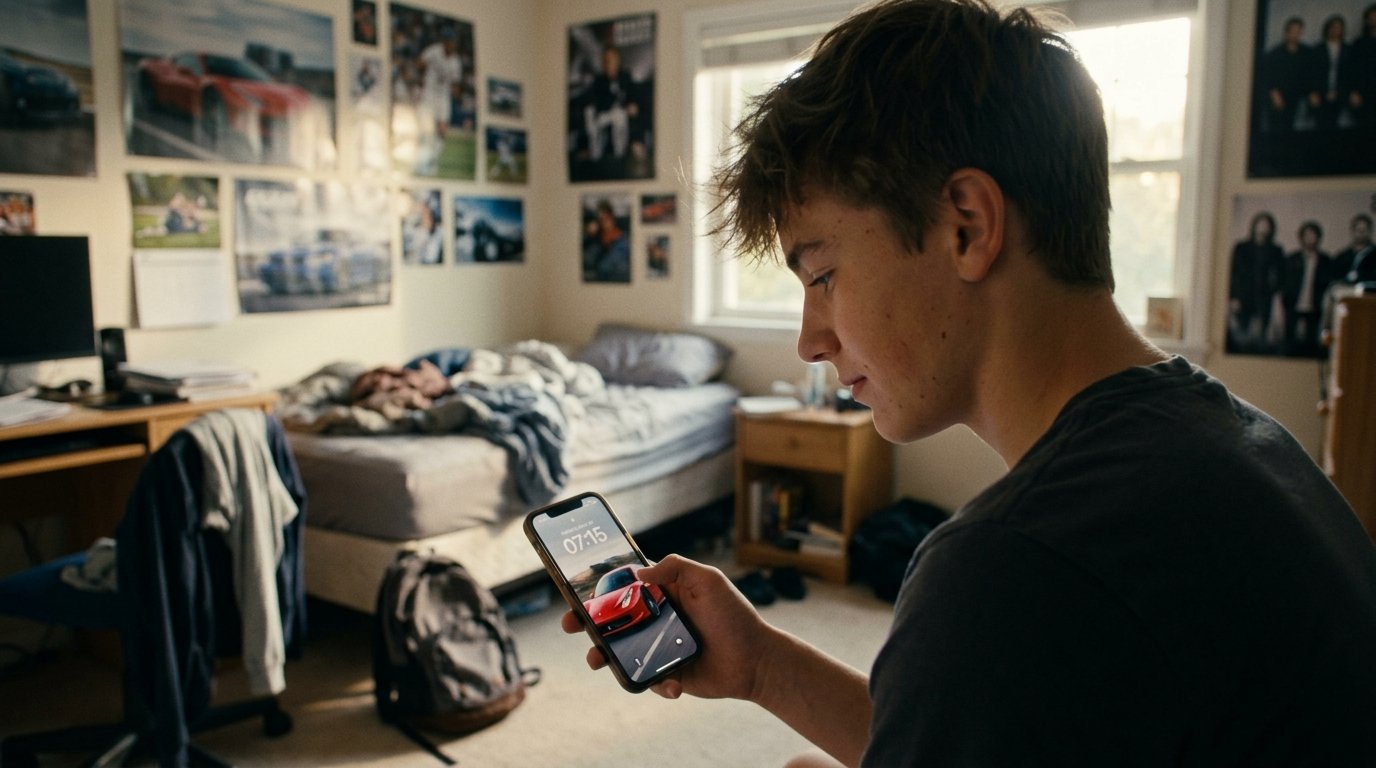
Find a photo of exactly what you are saving for and make it your lock screen. You see that screen a hundred times a day: a hundred tiny reminders of what your money is for. It sounds silly. It works ridiculously well.
One goal, not five. When everything is a priority, nothing is. My lock screen was a red Honda Civic for fourteen months.
6. Track Every Dollar for One Month
For exactly one month, write down everything you spend in your phone’s notes. Not forever, just thirty days. Most teens find $60 to $100 a month on stuff they cannot remember: vending machines, app purchases, mediocre snacks.
One month of data shows your leaks; then fix the two biggest. Mine were energy drinks and in-game purchases.
7. Pack Lunch Three Days a Week
School lunch or fast food runs $8 to $12 a day. Packing three days a week at about $3 a day saves roughly $20 weekly: $80 a month, over $700 a school year. Real goal money hiding in your backpack.
Three days is the sweet spot: enough to matter, not enough to hate. Batch it Sunday night. Pack what you actually like, or you will quit by week two.
8. Sell What You Don’t Use Anymore
Your room is an uncashed savings account. Old games, outgrown clothes and sports gear, that sixth-grade instrument: list it all on a local marketplace app in one weekend. Most teens find $200 to $500 without trying.
Put 100 percent of selling money straight into the goal bucket. Take decent photos, price 20 percent below going rate for fast sales, meet buyers in public with a parent nearby.

9. Say No to “Splitting” Expensive Outings
The fastest teen budget-killer is the group outing: the expensive restaurant, the concert, the mall trip. You do not have to say yes to keep friends. Suggest the cheaper version: pizza at your place instead of downtown.
Keep two or three cheap alternatives ready so “no” never sounds lame: the park, a home movie night, pickup basketball. Nobody ever stopped inviting me, and my goal fund grew while everyone else’s stayed at zero.
10. Bank Half of Every Birthday Check Before You Spend It
Birthday money, holiday cash, gifts: half goes to the goal before you spend any. Got $100 from grandma? $50 to savings immediately, then enjoy the other $50 guilt-free. This one rule adds hundreds yearly with no felt sacrifice.
Gift money evaporates fastest because it feels free. The half-rule works because the other half is truly yours to blow.
11. Get a Summer Job With a Savings Target
Summer is where teen savings are made. Ten weeks full-time at $12 an hour is nearly $4,000 before taxes. Set the target before summer starts: “I will save $2,500.” Write it down, tell your parents, set the lock screen photo.
Decide the split before the first paycheck, not after the tenth. Lifeguarding, retail, food service, lawn care: the job matters less than the plan.

12. Avoid Buy-Now-Pay-Later Traps
“Four easy payments” buttons are debt dressed as convenience, aimed directly at you. Miss one payment and fees start. Stack a few plans and they eat your paycheck before you see it. A trap with good marketing.
The rule is absolute: if you cannot pay in full today, you cannot afford it today. Save up and buy once, or do not buy. Every debt-drowning adult I know started with “easy payments” as a teenager.
13. Learn One Money Skill a Month
Each month, learn one practical skill: reading a pay stub, comparing unit prices, how interest works, spotting scam texts, writing a simple budget. Twelve skills a year puts you ahead of most adults.
Free resources are everywhere: your bank’s teen section, library books, school counselors, your parents. I learned to read my pay stub at seventeen and found my employer underpaying my hours for two months. That skill paid me $180.
14. Celebrate Milestones Without Spending the Milestone
At 25, 50, and 75 percent of your goal, celebrate free: a home movie night, a park day with friends, your favorite home-cooked meal. The reward is marking progress, not spending it.
Most people quit in the boring middle, when novelty wears off and the finish is far. Milestones break the middle into short wins. I marked every $500 on a paper thermometer in my closet. Watching it fill was its own reward.

Mistakes That Kill Teen Savings
The number one killer is lending money to friends. You will not get it back, and asking ruins the friendship. The kindest answer is simplest: “Sorry, all my money is going to my car fund.” A named goal is a socially acceptable shield.
Second is the weekly “I deserve it” splurge. Build small treats into the 50 percent spending bucket so treats are planned, not emotional. Third is keeping savings and spending in one account. Separate accounts are not optional. They are the system.
A Simple Savings Tracker
One tracking tool: a phone note or paper with three columns. Date, amount added, new total. Update it every time money enters the goal. That running total is your motivation engine.
Monthly, compare your total to your goal math. Ahead? Keep going. Behind? Adjust now: pick up a shift, sell something, trim a leak. Five-minute monthly check-ins keep small gaps from becoming failed goals.
Conclusion
My brother’s $2,000 car fund looked like magic until he showed me the system: separate account, automatic split, named goal, lock screen photo. I copied it and graduated with $3,400. Pick your goal, price it, split every paycheck, watch the number grow. Start with this week’s money.